Unveiling the Secret of 'Kagemusha': From Sengoku Strategy to Genshin Impact
Genshin Impact's Kagemusha traces back to Japan's Sengoku shadow warriors, a role of body doubles that evolved into fictional hidden masterminds.
It was the late summer of 2021 when the buzz around Genshin Impact’s Version 2.1 update reached fever pitch. Among the storm of leaks, character teasers, and story predictions, a single Japanese word kept popping up in community discussions: Kagemusha (影武者). As someone who had grown up on classic anime and spent years dabbling in Japanese language, the term immediately resonated with me—but I noticed plenty of newer players scratching their heads. The curiosity swirling around that word sent me on a nostalgic deep dive, re-examining not just the game’s narrative but also centuries of history and storytelling that shaped its meaning.
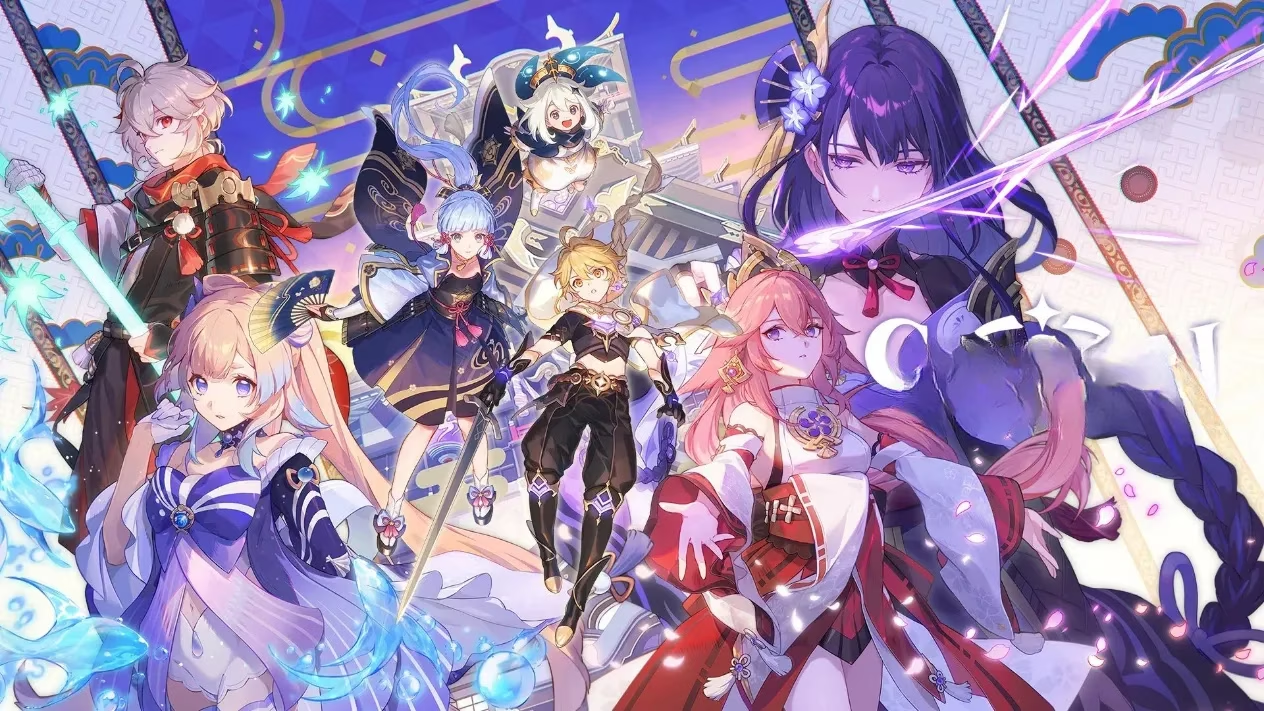
My first encounter with the word happened long before Teyvat existed, in the context of Akira Kurosawa’s 1980 masterpiece Kagemusha. The film tells the story of a petty thief who is forced to become the double of a dying warlord, preserving the clan’s unity during the chaotic Sengoku period. Even then, I felt the weight of the concept: a shadow warrior, a living decoy, someone who sacrifices their own identity to protect a greater cause. That association primed my mind when I finally saw the same term surface in Genshin Impact’s Inazuma arc. Little did I know that the historical resonance went much deeper.
The Historical Roots: Shadow Warriors of the Warring States ⚔️
To fully grasp why Kagemusha carries such dramatic weight, you have to travel back to Japan’s Sengoku era (c. 1467–1615). This was a time of near-constant military conflict, where warlords (daimyō) fought for supremacy with cunning as much as with steel. One of their most fascinating strategies involved the use of kagemusha—body doubles who would dress and act identically to their lord. These stand-ins could be soldiers with a passing resemblance, family members, or sometimes even coerced commoners. Their job was to mislead enemy scouts, confuse assassins, or keep an army’s morale high when the real leader was incapacitated.
| Sengoku Period Usage | Modern Fiction Interpretations |
|---|---|
| A physical double on the battlefield to decoy enemies | A political decoy who dictates commands from behind the scenes |
| A dead lord’s corpse replaced to hide his death | A body double used to erase evidence in a murder mystery |
| A figurehead maintaining the illusion of leadership stability | A secret puppeteer manipulating events without ever showing their face |
This table mirrors exactly the semantic evolution I rediscovered while researching. The word originally had a very concrete military function, but as storytelling evolved, so did the concept. Modern Japanese uses kagemusha to describe anyone who operates in the shadows—a hidden advisor, a behind-the-scenes mastermind, or even a scapegoat who takes the fall for someone else. Anime and video games absolutely love this duality, and Genshin Impact picked up that narrative baton with irresistible elegance.
A Blast from My Anime-Soaked Past 📺
Before social media could do the explaining, older anime fans like me had already internalized kagemusha through shows that premiered over a decade ago. I vividly remember watching Hikari to Mizu no Daphne and stumbling over the term in a plot twist. The series used a kagemusha to hide the true identity of a central character, layering the story with paranoia and intrigue. That experience stuck with me, and it’s part of why our generation tends to hit up dedicated online Japanese dictionaries first instead of googling a broad term. We know that language nuances carry entire narrative subtexts.
Another cultural touchstone is Kurosawa’s Kagemusha, which I rewatched after the 2.1 spoilers emerged. The film’s palette of vivid colors and its deep meditation on identity and deception suddenly felt like a direct spiritual ancestor to the questlines I was about to play. In Genshin Impact, although I won’t spoil the precise events, the word Kagemusha is more than a title—it hints at the hidden structures of power in Inazuma, at puppeteers who control events without stepping into the limelight. The Shogun, the commissions, and the rebel factions all dance around a truth that isn’t seen on the surface: someone is pulling strings, and the concept of a shadow warrior is the key to understanding it.
The Living Language of Teyvat 🎭
What fascinates me even now, five years after Version 2.1 launched and as the game has expanded into nations like Natlan and beyond, is how miHoYo wove real linguistic heritage into their world-building. The Inazuma chapter is steeped in Japanese cultural vocabulary—kagemusha, shogun, tenryou—but it uses these words not as mere flavor but as narrative clues. When the patch finally dropped on September 1, 2021, I remember rushing through the story, my heart racing every time the term appeared on screen. It was a scavenger hunt where my own background knowledge became a third-party decoder ring.
“A kagemusha gives instructions while remaining unseen. That definition alone should make any lore enthusiast pause.”
This line, which I later jotted down in my travel notes, captures the essence of the word’s modern usage. Unlike a mere body double who simply mimics appearance, a contemporary kagemusha embodies the idea of remote control—power exerted quietly from a hidden vantage point. In Genshin Impact, this plays out through political maneuvers, Archon duties, and even personal sacrifices. The narrative never explains the term in a dry essay; instead, it lets the player gradually piece together who is the shadow and who is the shadow caster. That respect for audience intelligence is something I deeply appreciate.
Why Words Like This Matter for Cultural Bridges 🌉
A casual observer might wonder why a single Japanese word sparks so much discussion. For me, it’s a perfect example of how games can become gateways to cultural literacy. The Genshin Impact community back then was filled with posts analyzing Japanese etymology, historical references, and folklore. Newer players suddenly wanted to understand kagemusha not just for the story but because it connected them to a richer tapestry of film, history, and language. I’ve lost count of how many friends told me they started learning Japanese because of Inazuma, and that word stood out as one of their first “aha!” moments.
Let’s also appreciate the secondary meanings that enrich the concept:
-
影 (kage) – shadow, silhouette, a reflection that isn’t the real thing.
-
武者 (musha) – warrior, but also a person of action bound by a code.
Put together, a kagemusha is literally a “shadow warrior,” a ghost fighting in someone else’s name. In a game about visions, ambitions, and the masks we wear, this couldn’t be more apt.
The Puzzle Pieces Falling Into Place 🧩
I still recall the thrill when my pre-existing knowledge dovetailed with the game’s reveals. The subtle hints about certain characters’ true roles, the careful camera angles that avoided showing a face at crucial moments—it all clicked into place because I understood what a kagemusha was before the game spelled it out. That sense of shared language between creator and player is a rare gift. And even for those who didn’t know the term, the context slowly unveiled its meaning, making the eventual revelation feel earned rather than handed over.
Of course, I have to issue a gentle spoiler warning even today: if you are one of the few who haven’t yet experienced the 2.1 storyline or the subsequent chapters that build on these themes, tread carefully. Knowing the definitions behind kagemusha can fundamentally color your perception of certain events, because the word itself is a promise of hidden layers. But if you enjoy detective work, I’d say embrace the foreknowledge and use it to spot foreshadowing everywhere.
Final Thoughts: Shadows That Endure 🕊️
Looking back from 2026, with Genshin Impact’s world more expansive than ever, the word kagemusha remains a touchstone for me. It encapsulates why I love cross-cultural storytelling: a single term can carry the weight of a historical epoch, a cinematic landmark, and a video game’s most intriguing plot twist all at once. Whenever I see new players discovering this word—whether through reruns of old events or YouTube lore recaps—I smile, remembering my own journey from Kurosawa to Inazuma.
The shadows of the Sengoku era may be centuries old, but they still dance in the realm of Teyvat. And as long as stories keep being told, the kagemusha will keep slipping through the cracks, controlling fate without ever showing their face. That quiet, hidden power is exactly what makes this concept timeless—and exactly why a nerdy interest in Japanese language ended up being one of my best Genshin assets.
⛩️ May your pulls be lucky and your lore deep.